Monday, 14 May 2012

Gardening Gamble

It's a huge gamble this, planting and sowing so late in the year. I'd be twitchy doing it so late on even in southern England, let alone southern France.  Every day the searing heat of summer gets closer so it's a real race to get things to grow enough roots beforehand to make it through to autumn.


However, various factors prevented it from happening earlier so I just have to hunker down and get on with it, fast! 


But what to plant.. I wrote last week about taking inspiration from the wild plants nearby but just as importantly I've inherited lots of plants bought last autumn when M drove back from the UK. In this kind of gardening, you intentionally limit your plant palette, and plant lots of each to maximise their impact. So each one is carefully chosen and has at least one purpose:


We have two grasses - Miscanthus nepalenis (a slightly tender, rather refined Miscanthus - its close relative Miscanthus x giganteus grows to 3.5m in a season and is used as biofuel). This will add height and its arching flowerheads should catch the light beautifully;


Next comes Stipa tenuissima (Feather Grass), which is small, soft and very tactile so will go nicely along the path - a delight to bare legs as well as the eye! It's extremely finely-textured, and turns a rich gold over the summer - one of the best plants I know for combining with others. Here we're pairing it with the fat, fleshy, red wine-coloured leaves of Plantago 'Rubrifolia', among others.


There are a few others - some potted, some direct sown - too many to detail here without the risk of making this blog into an essay! So I'll sign off with something that brought a smile to my face. I've sown various Agastache, Hummingbird Mints from the southern USA and Mexico. A well deserved common name, as this video shows: http://www.youtube.com/watch?v=2DJPy5X5M-s&feature=related 

Sunday, 6 May 2012


It was one of the ideas that brought me here; furiously stoking my curiousity and igniting my passion for design. A Prairie Garden, in Provence?

Prairie Gardens take their inspiration, obviously, from the Great Plains of North America - huge swathes of grassland full of a range of flowers Europeans could, until relatively recently, mostly only dream about. These landscapes inspired the ‘New Perennials’ movement that has emerged in Northern Europe over the last twenty years. It’s naturalistic, a far freer, a more sustainable look for the 21st century - compared to traditional hidebound notions of colour-themed mixed borders, staked, straightjacketed; over-fed and overwatered. Here you pick a limited palette of appropriate plants, flowering perennials and grasses, set them out en masse, stand back and watch the spectacle unfold.*


Yes the setting does help...
So far so easy, right? It’s now a tried and tested formula that has been proven time and time again... in northern Europe.
So how to translate it to a setting within sight of the Mediterranean, (i.e. drought from June to September), with no irrigation? Many classic prairie plants like Echinacea are drought tolerant but not really drought loving. We need plants that will actively thrive. Time to look at the ground beneath our feet..
The wild plants locally gave me some great clues - wild verbascums, poppies and sages all thrive on this dry alkaline soil and have cultivated (or cultivable) relatives that are worth looking at. The dreaded plantains, even, have a cultivated cousin - Plantago major ‘Rubrifolia’ - a fantastic foliage plant the colour of red wine which will make a great contrast to the tawny colours of late-season grasses. And it doesn’t even mind being trodden on occasionally - what a plant!

So - time to get weeding. Hoiking out these rambunctious country cousins (and a hell of a lot of thistles). It took two of us three whole days of pulling and digging to get the site clear.
My huge pile of thistles looking more like rather forked parsnips!
For orientation the Bay of Cannes is visible on the horizon

Getting a bit obsessed at the end of day three....
Some of the roots were as long (and nearly as thick) as my forearm
Beautiful drooping panicles of wild oats (Avena nuda) on a lower terrace.
It's a shame they're so invasive...
I'm going to use their much better-behaved cousins, the Stipa tribe.


*by using plants in bulk you maximise their impact, it’s incredible how much more you can get from them... don’t feed, don’t water, don’t stake, just let them do their thing and appreciate them for what they are.

Saturday, 5 May 2012

Great Holiday. Not Many Dead...

How inconsiderate... getting hitched in April, I mean honestly!

To be fair to my dear friends Beth and Gemma they did announce their ceremony long before I'd even heard of this garden... but still I winced as I booked my tickets back to the UK -  even just five April days away from our menagerie of tender young plants is a big deal.

The infamous Pelargonium x ardens (in big terracotta pots
with  Aeonium 'Zwartkop') just beginning to flower.

Luckily everything survived: -  rare Canary Island echiums, tiny bottlebrushes and even the fabulously delicate Pelargonium x ardens whose deathwish I wrote about just a couple of weeks ago -  they all sailed through under the watchful eye of C.


....Apart from that is a tray of the commonest, easiest plants imagineable. African marigolds ('Simba') - which were to be a companion plant for the tomatoes. I didn't get time to pot them on from their tiny modules and now they have, just like Monty Python's famous parrot, "ceased to be"!


A salutory lesson that one shouldn't neglect potting things on...


Lots of leaves, not much compost + one hot windy day =


A walk on the wild side


A sunny spring walk with the Mediterranean Garden Society (MGS), and Benoit Beauvallet from Pépinière de l’Armalette up in the wilds of the Haut Var. If you'd like to see bigger images please click here


Euphorbia serrata - left - showing fantastic yellow bracts
Psoracea bituminosa (syn Bituminaria bituminosa) - a leguminous plant with leaves that smell of burnt rubber
Lonicera etrusca - members were surprised to see this growing as a shrubby plant, rather than the more usual climbing habit of many honeysuckles


Pistacia terebinthus  - left - the turpentine tree. Closely related to the pistachio. A deciduous tree with great autumn colour; was showing a good deal of bright red bloom on the day of our visit.

Rhamnus alaternus - buckthorn - a very adaptable evergreen, as good in shade as on baked slopes. 


Isatis tinctoria - left - woad - used as a blue dye in ancient times.
Juniperus oxycedrus - a juniper with large, toxic berries. Gin fiends beware!


Eryngium campestre - a demure native sea holly with subtle colouring. Alas many had suffered from being strimmed!


Amelanchier ovalis - left - the only native European amelanchier, showing flowers on some plants.

Asplenium ceterach - incredible to see a fern growing in such arid conditions - this one copes by going dormant and dessicating completely in the summer, to regrow whenever rainfall is sufficient!


Cephalaria leucantha - a giant scabious which harsh conditions had made somewhat more compact.

Rubia peregrina - wild madder - in the Rubiaceae tribe which includes coffee and quinine! a delicate looking plant with sharp scaly foliage.


Thymus vulgaris - commonn thyme, showing typical variation in habit and flower colour
Pinus halapensis / Pinus nigra - forming small woods
Viburnum tinus - well known shrub doing its thing in the wild.
Plantago sempervirens -  left - a very surprising find! A shrubby plantain, related to the dreaded lawn weed, as evident from its flowers

Euphorbia spinosa - a diminuitive spurge making neat mounds. Perhaps this would be a good alternative for gardeners who are sick of the invasive tendencies of E. cyparissias?
Lavandula latifolia - Spike Lavender - strongly aromatic lavender (more camphorous than angustifolia types) - distinguished by its branched flowerheads. Compact growth and dark blue flowers.

Anthyllis montana - Mountain Kidney Vetch -  see left - a real highlight of the trip - a splash of crimson on a high rock ledge, its flowers have an intoxicating scent of raspberries and vanilla. Benoit thought they may be used to make a type of jam!
Helichrysum stoechas - curry plant

Cotinus coggygria - another common garden plant doing its thing in the wild!


Helianthemum oelandicum - left - a tiny sunrose with bright yellow flowers. 

Stachys recta - dwarf stachys looking more like a shrunken salvia! Yellow flowers. Its size varies according to location.
Teucrium paulium - lovely little germander with very bright whitish foliage
Thymelaea diocia


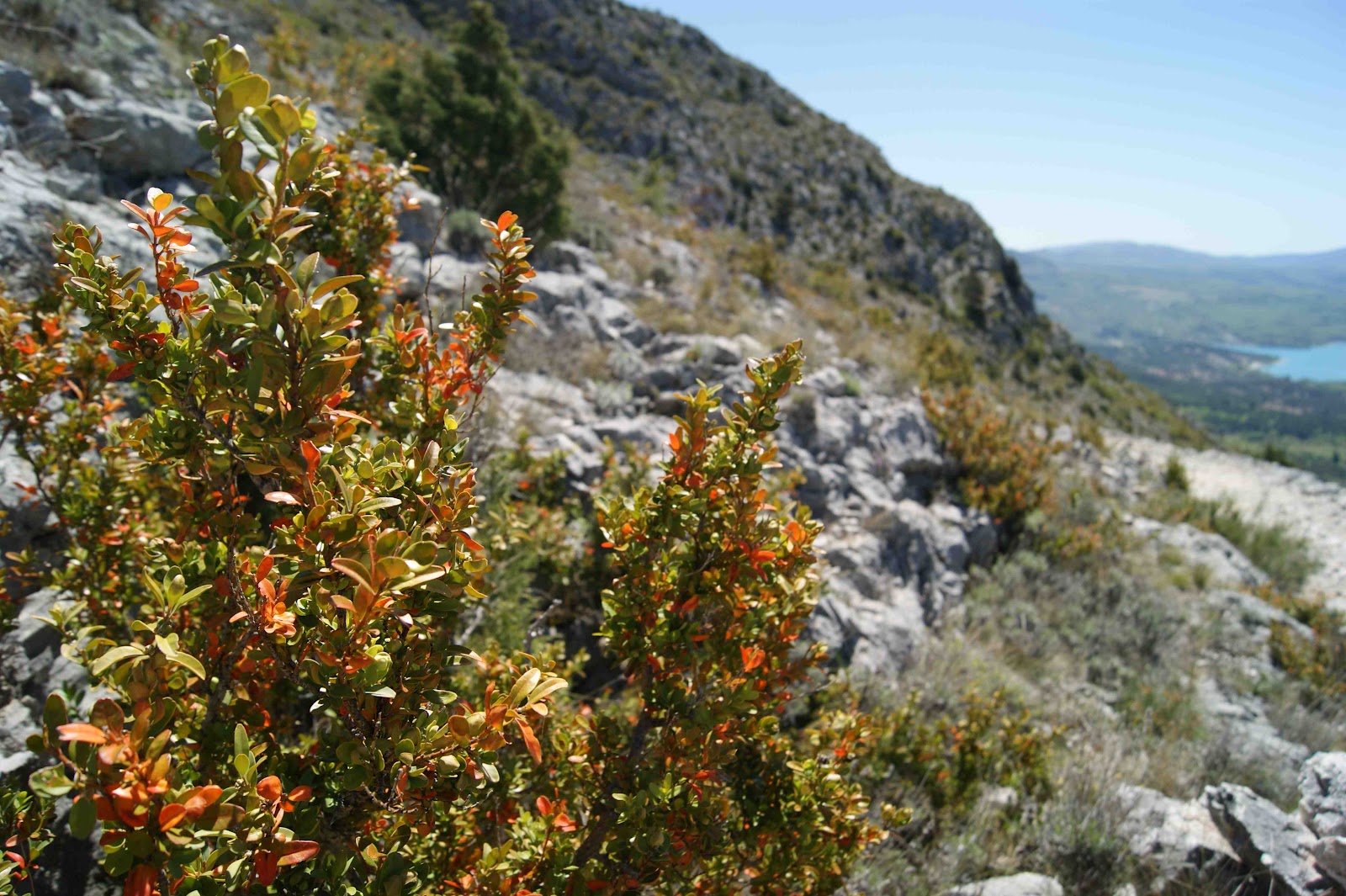
Buxus sempervirens - common box, showing bright orange leaf coloration brought out by the cold winters.
Helleborus foetidus - stinking hellebore - in shady parts of the woodland.

Aethionema - a diminutive member of the cabbage family, Brassicaceae.


Globulara cordifolia (left) - delightful small plant with comparitavely large bluish-mauve flowers. 

Sedum sediforme - a great plant to grow anywhere - even under cypresses apparently!
Clematis flammula - a beautiful fragrant clematis with small white flowers, sadly not in bloom


Tuesday, 1 May 2012

Some people think I'm bonkers...

...and they're probably right, but there is method in the madness.

A very exciting day today in the new vegetable garden. After all the long haul of rotivating, installing irrigation, laying the calade (paving), spreading wood ash and sheep manure came the fun bit...

We're calling it a potager, and placed as it is in the heart of the garden, it needs to look good. But not in a Villandry [row upon row of inedible ornamental cabbages, more hedges than beds] or Rosemary Verey (vegetables something of a garnish to yet more sodding roses) way. In a smart, practical way.

So I've formalised the layout with a box plant symetrically placed at each corner of the calade. I lifted them from the storage beds by the compost heap and carefully wrapped the roots in damp hessian. So far so good, so normal...

The biggest challenge to freshly moved plants is dessication - however careful you are it's impossible not to damage some of the microscopic root hairs that draw water from the soil. So the leaves wilt and look miserable for a bit. Or die. A bit of a lottery. So when the sun came out and the wind blew ("good drying weather" Mum would call it when she was doing laundry) I panicked...

The best way to stop plants drying out is to keep the wind off them and dampen the atmosphere... so I watered my precious box, and then as it got hotter and I kept working, steadily shed layers of clothing. Well, a T shirt lying uselessly on the ground when it could be put to much better use....

More photos of from the end of the day here


Monday, 30 April 2012

Blogging backwards... the front of the backlog!


Old olives on the main lawn - sudden shafts of light and
piles of silvery branches strewn about gave the garden
 a strange underwater atmosphere

A procession of ominously titled men have invaded the garden of late. Perhaps I have seen too many horror films, but the annoucement that “‘The Olive Man’ will be with us shortly” sent a shiver down my spine. 

He did the kind of pruning job that we lowly gardeners can only dream about... spend all day up trees in the sunshine, using powered secateurs (hydraulic?), and then waltzed off into the sunset, leaving someone else (i.e. us) to clear up!

It’s an old cliché.. owners ending up looking like their dogs. Well The Olive Man definitely has something of the olive about him... small and round, with bright dark eyes and shiny skin. The Cypress Man  - who comes to trim the huge Italian Cypresses at the front of the house - is accordingly tall and springy. He arrived in a tiny Renault with huge ladders strapped to the roof, doubling its length. And a gorgeous little terrier cross called ‘Beeper’!

everybody say "ahhhh...."

Sunday, 1 April 2012

A splash of colour


Yesterday I woke from my siesta to the sound of wind whistling through the cypress tree that grows just outside my bedroom. I rushed straight out, my thoughts firmly on closing the cold frames, looked up and was astounded.
People often write, mainly in clichés elegant or otherwise, about the ‘intense’ ‘dazzling’ ‘mesmerising’ blue of the sky in Provence. Coming from London where the sky is often just a grey smudge between buildings, I tend not to pay much heed. Yesterday was different. 
Suddenly the normal view of rolling foothills, (the last of the Alps as they crash haphazardly down to the Mediterranean, their feet lost in haze), was gone. Instead, a flattened and sharpened view, almost as if it had suddenly become 2D - hard angles everywhere of jutting cypresses and their deep shadows. The customary smudge of sea fading to sky across the horizon replaced by a hard blue line, Prussian Blue sea to azure sky.
So, ‘this is the Mistral’ I thought. It’s the wind that drove Van Gogh mad - but here, sheltered as we are by the escarpment, we escape its worst effects almost entirely. But I'm still gobsmacked by the way it changes the light and how clear it makes the air. When it was at its height, Corsica appeared in the far distance - which according to Google Earth is over 100 miles away!

Already bright colour suddenly become supersaturated - the whole world looks like it’s been photoshopped. Beautiful wild anemones in shine deep red in the meadows and I made a surprising discovery digging the potager - a turgid little bit of rhubarb sprouting shocking pink underground from a discarded root.